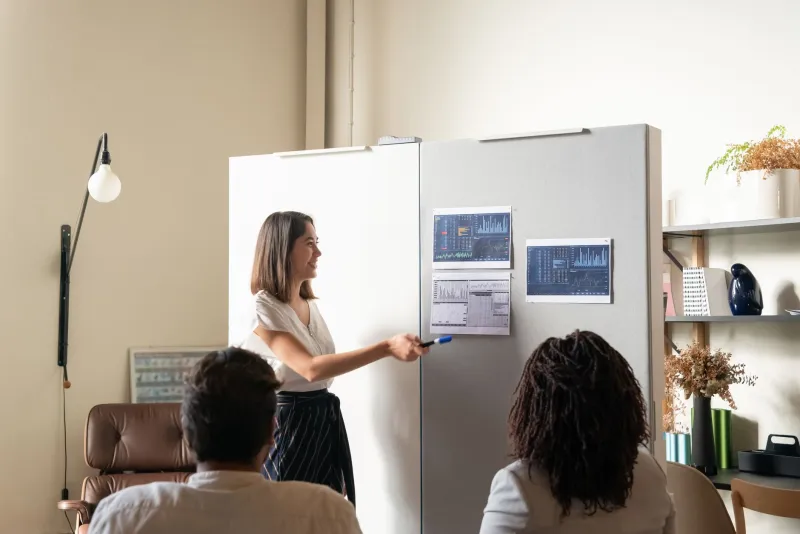
Every Meeting You Didn't Need Is Code You Didn't Write — And Women Are Paying That Bill

There's a particular kind of exhaustion that doesn't show up on a burnout quiz. It's the 2 PM feeling of opening your IDE after back-to-back standups, a product sync, and a "quick" Slack huddle that somehow lasted forty minutes — and realizing you have exactly ninety minutes left in your workday to write actual code. You're not tired from the work. You're tired from everything that kept you from it.
For women in frontend development, this isn't an occasional bad Tuesday. Research consistently shows that women in tech are disproportionately invited into meetings, disproportionately expected to take notes in those meetings, and disproportionately held responsible for the relational glue that makes cross-functional collaboration feel smooth. That's not a coincidence. It's a pattern — and it has a real cost.
What the Research Actually Says
A 2021 study from Harvard Business Review found that women are more likely than men to be pulled into collaborative tasks and synchronous communication at work, even when their individual contributor role doesn't require it. Separately, Microsoft's 2022 Work Trend Index reported that the average Teams user attended 153% more meetings than they did pre-pandemic — but the burden of that spike wasn't distributed equally.
In engineering specifically, a study from the National Bureau of Economic Research found that women in technical roles spend significantly more time on what researchers called "organizational citizenship behaviors" — the stuff that keeps a team functioning but rarely appears in a performance review. Meeting attendance, conflict mediation, onboarding support. All of it valuable. None of it credited.
For frontend developers, this matters in a specific and painful way: frontend work is cognitively expensive in a way that's easy to underestimate from the outside. You're not just writing logic. You're holding component hierarchies, state trees, accessibility requirements, design specs, and browser inconsistencies in your head simultaneously. That mental model takes time to build. A single interruption doesn't cost you five minutes — it can cost you twenty to thirty minutes of re-entry time, a phenomenon psychologist Gloria Mark has documented across multiple studies on knowledge workers.
So when your calendar is fragmented into forty-five-minute windows between syncs? You're not just losing time. You're losing the conditions under which good frontend work actually happens.
Why Women Get Called In More
Let's name what's actually driving this. It's not that women are worse at protecting their calendars (though the advice to "just block focus time" ignores a lot of real social dynamics). It's that organizations unconsciously — and sometimes consciously — treat women's time as more available and more communal.
Women who push back on meeting requests often face a specific flavor of professional consequence. They're described as "not collaborative," "hard to reach," or "not a team player." Men who protect their deep work time are more likely to be described as "focused" or "high output." Same behavior, wildly different label. That asymmetry means women face a genuine double bind: attend every meeting and sacrifice your output, or protect your output and risk your reputation.
There's also the meeting-note problem. If you've ever looked around a conference room — or a Zoom grid — and realized that you are, again, the person typing, you know what this feels like. Note-taking is low-status work that gets assigned to women at a statistically significant rate. It's also a role that anchors you to the meeting itself rather than letting you participate as a peer.
The Career Momentum Problem
Here's what doesn't get talked about enough: excessive meeting load doesn't just hurt your current sprint. It affects where you end up.
Career advancement in frontend development is increasingly tied to visible technical output — open source contributions, shipped features, architectural decisions, technical writing. All of that requires sustained, uninterrupted focus. If your calendar is consistently more fragmented than your male peers', your portfolio of visible work will reflect that over time. Not because you're less capable, but because you had fewer hours in which to produce it.
This creates a compounding disadvantage. Less deep work time means less impressive output. Less impressive output means fewer sponsorship opportunities. Fewer sponsorship opportunities mean slower promotion. And then someone — maybe you, maybe your manager — looks at the trajectory and wonders why progress feels so slow.
The meeting tax is a career tax. Full stop.
Tactical Ways to Start Reclaiming Your Time
Okay, so what do you actually do about it? A few things that work in practice:
Audit your calendar before you try to fix it. Spend two weeks tracking every meeting you attend, whether you needed to be there, and what you gave up to be there. Data is your friend when you're making the case to a manager or to yourself.
Name your deep work windows publicly. Block two to three hour chunks on your calendar and label them something visible — "Frontend focus block" or "Development time — async messages only." When the block has a name and a purpose, it's harder to casually override.
Propose async alternatives proactively. When someone tries to schedule a meeting, try responding with a Loom video, a written summary, or a shared doc comment thread. Frame it as efficiency, not avoidance. "I can get you this faster async" is harder to argue with than "I don't want to meet."
Stop taking notes by default. If you're in a meeting and you notice you're the only one typing, stop. Let the silence be someone else's problem to solve. If note-taking needs to happen, advocate for rotating responsibility explicitly.
Have the direct conversation with your manager. This one requires some political capital, but it's worth it. Come with data — your meeting load, your output targets, the mismatch between the two — and ask for explicit air cover to decline non-essential invitations. Most managers will respect a focused, evidence-based ask.
This Isn't About Being Anti-Collaboration
Worth saying clearly: none of this is an argument against teamwork, communication, or showing up for the people you work with. Collaboration is real and valuable. The problem isn't meetings — it's the unequal distribution of meeting burden, and the assumption that women's attention is the most renewable resource in the room.
You can be a great teammate and still insist that your focus time is protected. You can be communicative and still decline a meeting that could have been a Slack message. You can care about your team and still care about your own output.
Actually, protecting your deep work is how you show up as your best technical self. The code you write when you have real, sustained focus is better than the code you patch together in the margins of a meeting-heavy day. Your team benefits from that too.
So the next time someone says you're "not being collaborative" because you declined a sync that had no clear agenda? You can smile and say you're being very collaborative — you're making sure the work actually gets done.